
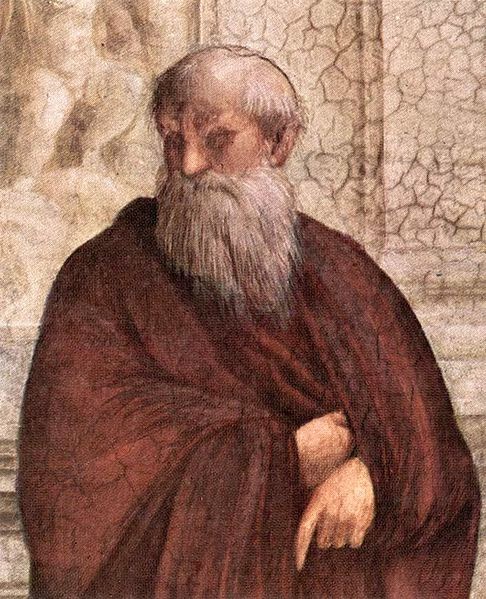
Plotinus believes beauty is recognition of soul expressed in the body, or form expressed within matter, given things can be recognized as more or less beautiful, he maintains soul can express itself in matter to greater or lesser degrees — he believes this is possible because he maintains form and the stuff of matter to couple as a composite, ugliness he explains, is something of a failure of the stuff of matter to cohere to the form. Plotinus does also explain sympathy to beauty as soul recognizing material coherence to form (or soul recognizing itself in a way), and antipathy to ugliness as repulsion to that which is unlike it.
Where Plotinus falls short here is in his position of form and matter forming a composite, at some point the stuff of matter must be wholly of the Absolute which necessitates its own coherence with perfection; soul or the One, as well as form (form of the smallest building block of matter, for instance). The relationship of soul and body being one of a composite or couplement is not an accurate assessment, the soul is not the possessor of a body, rather the body is the expressor of the soul. There can be no coupling of principally unlike things. This relationship would not account for the generation of bodies, it would posit the soul as merely conveniencing itself upon bodies that are generated anyways. This is broadly what I call the soul possession misconception.
Plotinus implies that the body or stuff of matter does attempt to cohere to the soul, implying it’s subjugation therefrom — logic dictates that body or the stuff of matter would not be a distinct and possessed clay that the soul moulds to express, rather the direct materialization to express the condition of the soul. This logical dictation is more in line with hypostases as necessitatively expressions of the One, as well as their antecedent principles. Beauty could not then be indicative of greater coherence to soul or antecedent principle, as that implies privation thereof, as everything must ultimately cohere to universal proportion — implying something doesn’t implies privation of the One.
Beauty should then be considered recognition of desired quality in the soul expressed in the form of bodies, this explains the universality of much beauty, much beauty being quote objective, as well as the many particularities found beautiful only to some — which would not be the case if beauty was plainly recognition of universal proportion or harmony. The sympathy towards beauty would then be impulsion unto that which is either like the self or what one aspires towards, and the antipathy towards ugliness would be that which is unlike the self or particularized individuation of the One, or the which the self aspires to be unalike — likeness or unlikeness being proximity to the souls expression of being.
I posit that what is considered bad or ugly probably only started to exist due to relativity or determinatio est negatio relative to consciousness becoming aware of what is desirable of itself, or the self configuration of the Absolute. Ie, what is undesirable is called into possibility by defining what is desirably expressed in the individuated being. This however, would only be a catalyst, a shadow to definition, contemplation of the shadow or the undesirable thereafter defines it, developing it from a negation (a shadow) to more of an opposition in practice, defined and with form.
Discover more from BREAKING NOUS
Subscribe to get the latest posts sent to your email.
 BREAKING NOUS
Leave a comment