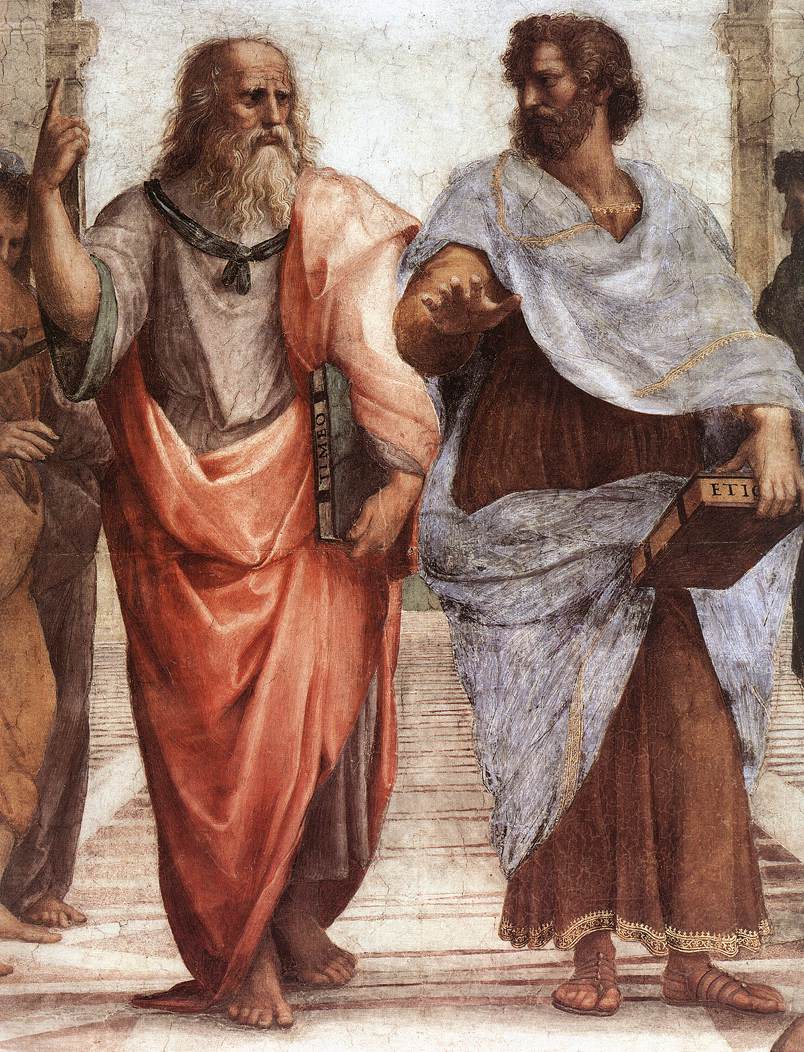
The essence of this point of contention between these two philosophical titans lies in the dynamics between the physical world and metaphysical principles underlying it. Both use the term “forms” to denote these kinds of metaphysical matrices, like the mould of an object, but not the object itself. In Platos theory of forms, he maintains that matter essentially maps itself onto these forms, and participates in those forms — though Plato is notoriously mischaracterized, so it’s likely that matter is seen moreso as a hypostatic procession from or materialization of the forms. Aristotle on the other hand posits hylomorphism, as the name suggests (hyle: matter, morphe: form) — he posits the dynamic between the immaterial and material as a composite one, that is, an object being a composite between its form and matter, as though the form was a literal matrix filled with matter.
In an idealist system of reality, matter should be explained as a kind of representation of ideal, mental or noetic activity. The integrity of such a system cannot be preserved when matter is considered or even treated as a principle (arche) external to the underlying ideal arche. The implications of both matters participation in form, and matters ability to form a composite with form, treat matter as a distinct principle to begin with. It should be noticed that matter is characterized by its being as form, why should there be several layers of form, of which matter is merely a reflective mimesis? Couldn’t it be that the material world is in essence the manifested form of the realm of ideal activity which catalyzes said manifestation of form as matter? Or more succinctly, that the world of matter is the formed ideation of an ideal realms activity, its registered self definition represented as form and image that we merely call matter? If there is an ideal form, it must manifest itself, such a form couldn’t exist without manifesting itself — such a manifestation could more accurately be considered the actual morphe; form of the ideal. Again, hylomorphism suggests that bodies are composites between the principles of matter and form, which immediately assumes a principal of matter distinct from form, but matter can never exist distinct from form, so why seperate the two at all?
All matter has form, elements have an atomic configuration and the atoms themselves have form — does the matter of the atom merely form a composite with the form of the atom? It’s not outrageous to suggest that forms can consist in one another, particularly microcosmic forms in macrocosmic forms — but in an idealistic system, it is more reasonable to hold the atom as the form itself, manifested of a formative (but not formed) ideal principles activity — which registers as an imaginal form which is identical to the material world we experience. Form should be representative of its cause, should we subscribe to a matrix like conception of form, the envelope is only pushed back — we then need to ascertain the cause back of the particular configuration of this immaterial matrix which is supposed to have form — which almost implies spatiality in itself, an attribute of the manifest.
In a Causal Explanatory Model (CEM) of Hylomorphism, wherein D = A belonging to C because of B, A is form, C is matter and B is a kind of essence or superform (maintained herein as mental activity) that is the ultimate cause back of both. We can interpret this model which is linked to Aristotles syllogisms as A; form, literally belonging to matter; C, and being caused by an underlying formative but non-form causal agent; B. Such an interpretation expounded by Peramatzis could salvage Aristotles hylomorphism in an idealistic system if there is no arche (principle) of matter ultimately exterior to the ideal principle, and would essentially amount to definitionalism: matter as the representation of mental self definition.
In summary, the common conception of both Platos Theory of Forms as well as Aristotles Hylomorphism within systems of metaphysical monism (to which both subscribed) fall victim to reification of matter as distinct in itself in consideration of its dynamism with the posited immaterial principles. If the common conception of Plato were correct, it might imply matter participates in forms, and it could simply push the envelope of determining the nature defined and formed reality since the nature of ideal forms would likewise have to be determined in a hypostatic procession. If the common conception of Aristotle were a good assessment of Hylomorphism, it would imply matter as a distinct principle couples with form to create a formed material composite, still making use of an immaterial matrix, but this doesn’t account for matter in itself. Neither conceptions satisfactorily account for matter in itself, though the common interpretations are likely faulty. Instead I’d maintain the emphasis on matter not as existent in itself or even a hypostatic procession from something immaterial (which implies that matter and whatever precedes it are exactly alike and vary only in scale, which still does not account for mental properties), but rather as the self-objectification of a subject (mind) or subjective conditions and activity. In this self-imaging dynamic, matter is the representation of mental activity — it is the registration of form, whereas the mental activity is formative.
It should be noted again as an important disclaimer that ancient philosophers, especially Plato, are notoriously misconcieved of and mischaracterized. It’s clear that Platos dialogues are purposely exotericized for public dissemination, while his true doctrine was reserved for students of the academy. He did popularize the noble lie after all. I find it very likely that for Plato, what are called forms are actually considered to be the causes back of formation, moreso akin to ideas rather than a realm wherein matrices of form or universals exist such that our worlds matter can map itself onto such forms. Platos conception was probably closer to subject object dynamics (objects as the subjects self-objectification), but it may have also been matter as a hypostatic procession of antecendent causes, self reference to the forms.
Discover more from BREAKING NOUS
Subscribe to get the latest posts sent to your email.
 BREAKING NOUS
Leave a comment