

The system I’m putting forward starts with a few fundamental assertions made about the One/the Absolute, which is indeed maintained to be Absolute, which is essentially that which is totally universal (non-particular) and without privation. This is necessary for a foundational metaphysical principle, because if there is something external to it (which is the only way it wouldn’t be universal/non-private) — that implies there is something underlying both the supposed “One”/”Absolute” and whatever is external to it such that the two could be related as distinct realities, it immediately implies a relational medium, which means there is indeed a more foundational principle — given the supposed “One”/”Absolute” and the supposed external reality are both subsumed unto an underlying relational medium, which now presents itself as a stronger contender for the foundational reality principle.
If there is no privation of the Absolute, then there likewise can be no greatening nor lessening of the degree to which it is immanent within any instance of ontological reality — because there is nothing external to it that might be mixed with ontological reality that could lessen its immanence. There could be no gradation of the One within itself, there could be no ontological lessening since it could not lessen itself (inherent contradiction) and nothing else exists to impurify it.
With that being said, the Absolute is indeed — as said in the Book of 24 Philosophers: “A sphere whos center is everywhere, and whos circumference is nowhere.” If your One is an Absolute reality principle, it couldn’t literally (even in a non-spatial immaterial, ontological sense) have a center at one point, beyond which it is less of itself, for the reasons described above. Which is a problem with an emanationist model if you take emanationism to be literal procession from the ultimate reality principle towards something else, an external ontological procession — for there is nothing to proceed unto.
Therefore we come to the reason for my propositions, because some procession of being indeed exists — but it is necessarily internal to the most universal principle. It is proposed that the ontological ladder is one of this universal reality principles self-particularization, occurring by an involutionary (self-involving) process of self-definition, which creates a triad of definition-condition-relation: essentially, the reality principle is suggested to be an ideal (immaterial/mental) nature, it’s self-involving activity (self because it’s the only thing that can be involved with) creates a kind of self-defined condition of a mind — however as soon as one mind is defined, another is defined by negation, hence relation.
Self-definition then is the process by which self-particularization occurs, given relation is also a product of self-definition — it’s also the process by which self-pluralization occurs, i.e. the process by which multituity or plurality occurs ultimately contained within a unified reality principle.
Continuing on self-particularization, it is the condition of an ideal nature which is now to some degree particular, because it is conditioned — the very first of these would be the most universal-instances of particularity, or the least particular particulars, so to speak. Those ideal conditions (beings) that are extremely universal, it is my proposition that these are the Gods — and to clarify, these would be beings, just the most universal ones posterior to the underlying ultimate reality principle. Following the Gods would be beings of increasingly particular conditions, down to humans souls and beyond — given reality is entirely consistent with itself, it follows that the more-particular is encased within that which is more-universal, the increase in particularity past the primary particulars (Gods) would likewise be their self-particularization and would be not only contained with reality at large, but also within their direct superiors in universality.
It doesn’t follow that from total non-particularity, very particular beings spawn, particularization, to be coherent, requires a consistently internal process — such that the more-particular is contained within the more-universal. The suggestion that Gods are merely adjacent to the beings of men is for this reason extremely inconsistent. The universality of the Gods, and their being reflecting to the whole of reality beneath them is the reason they are relevant, if they had no encompassing-relation with the Cosmos beneath them, then it couldn’t rightly be said the cosmos were beneath them — rather that they would be adjacent to the cosmos at the human scale and dissociated with it save for sharing in reality itself. I can only imagine such a relationship looking as shown in figure 1.

The relationship between particulars and the universal, as well as between the more-particular and the more-universal is necessary to establish a consistent and coherent metaphysic — the self-particularization model posited herein aims to satisfy both by maintaining that particulars exist within universals according to their scale — and are in fact produced within the more-universal by that more-universals self-definitive process, inherited from the reality principles self-definitive process. As above, so below, there is no principle change to something principally true to reality — processes and operations pertaining to Ontology are consistent throughout the whole of Ontology, changing only in scale of being, but remaining principally consistent.
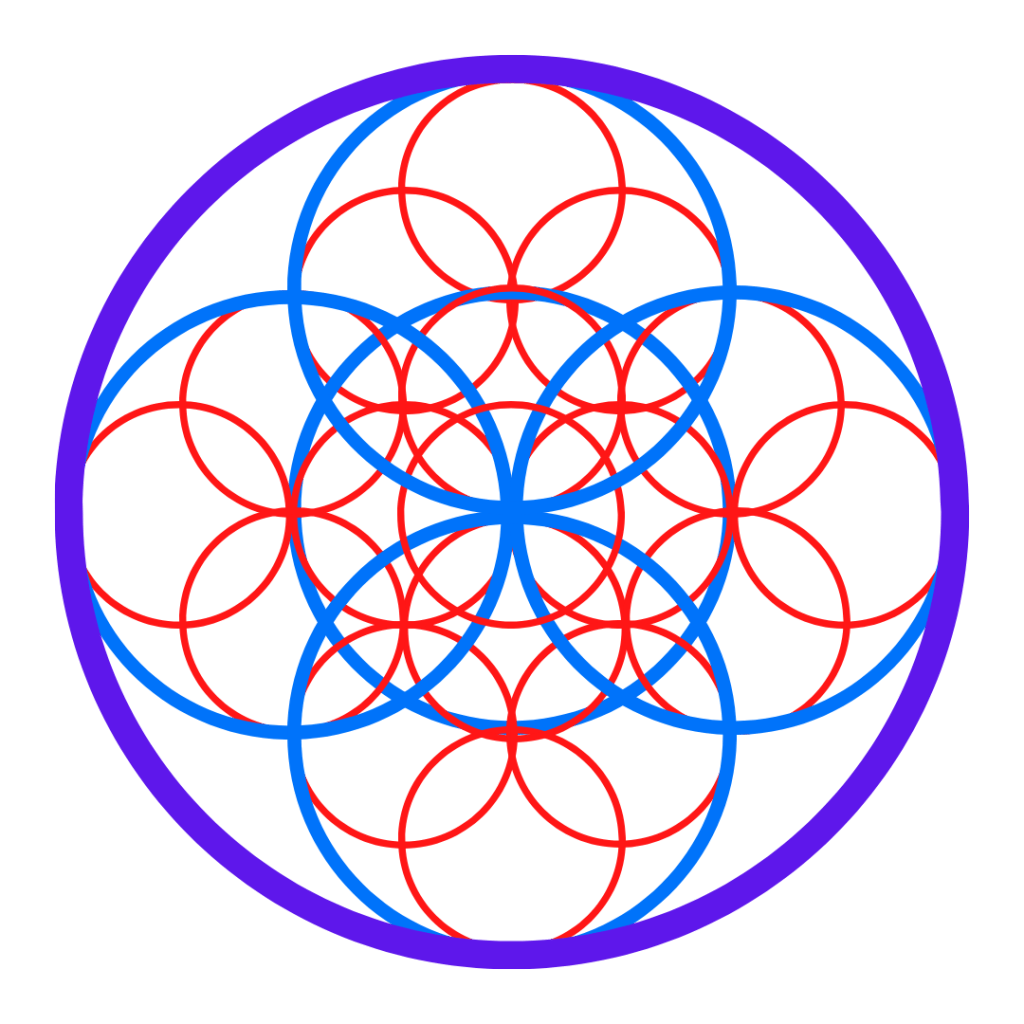
The relationship between particulars of a similar scale, such as between human souls, as shown in figure 2 — which is that of their relations being defined by similarity in condition (the overlapping sections in the red circles), is relayed in reality as we experience it. We will generally share in our experience of objective reality as according to our internal similarity, this almost tautologically proves itself, two similar people are likely to experience reality similarly, you and your direct relatives likely share in your experience of objective reality quite greatly, due to similarity in your internal soul-conditions (though we naturally reify our own uniquity). Likewise, those souls who have little relation to you will share little in your experience of objective reality. Someone on the other side of the world won’t have much in common with you, but they will share in the more-universal conditions that ultimately bind the more-particular — i.e. they experience the same world as you, the same experience of being human and ultimately the same reality, the you two wi— further demonstrating more-particulars being encompassed within more-universals, relayed in objective reality, which does reflect true conditions.
Further relaying this is the Monadology of Leibniz, summed in line 70: “Hence it appears that each living body has a dominant entelechy, which in an animal is the soul; but the members of this living body are full of other living beings, plants, animals, each of which has also its dominant entelechy or soul.” Leibniz’ idea underlying this is smaller scale monads exist within greater scale ones according to their quality, but that they could pass between greater scale monads. Of course, for the greatest scale monads, such as Gods, this would be impossible insofar as their conditions are indeed universal.
Another point against Gods that don’t subsume smaller scale beings is that it simply contradicts their universality — because the universal by definition encompasses and subsumes particulars, that’s why it’s universal. So if Gods didn’t subsume smaller scale beings, they wouldn’t be universal, rather simply other particular beings — prescribed with certain attributes that give them the status of Gods, but ultimately if you diminish the universality of the Gods you not only dimish a meaningful relationship between Gods and men, you also diminish their macrocosmic stature, instead reducing them to similarly particular beings that are powerful.
On the point that the subsumption of the more-particular souls of men into the being of Gods then recursively projecting the imperfection of men onto Gods, it will be countered and maintained that for the same reasons the Absolute is totally non-private, there exists no ontological imperfection — not even in human souls, because there is nothing external to being that could imperfect it in any meaningful ontological sense. Imperfection, evil and like things have no arche, no principle of being, and even though this diminishes the validity of that point raised against subsumption, I’ll explain an alternative conception of evil: that being object-orientation, meaning the souls attention being oriented on the sense-world, ignorant of the power back of it — which would plausibly cause all of the attributes of what is called evil. That being said, even this doesn’t diminish the perfection of the ignorant being, it doesn’t change its metastructure — in fact, the ‘negative’ recursive affection that object orientation has unto the soul, demonstrates the perfection of the souls operation (which needn’t arbitrarily extend to metacognition on a metaphysical level, this would be an arbitrary definition of perfection), given the condition of the soul is perfectly reflected in its experience of objectivity.
I’ll be finalizing this with quotes from Platonist and adjacent authors to corroborate the claims made herein concerning the relationship between the Henads and individual souls:
It is clear then that there is an eternal procession of souls, for it is said that the divine is always the same, not that it remains in itself, but that it is always producing. For it produces itself, in a manner, and again, it produces from itself the Soul, and from the Soul, the world.
Plotinus, Enneads VI.9.9 (Translation by A. H. Armstrong, published by the Loeb Classical Library in 1966)
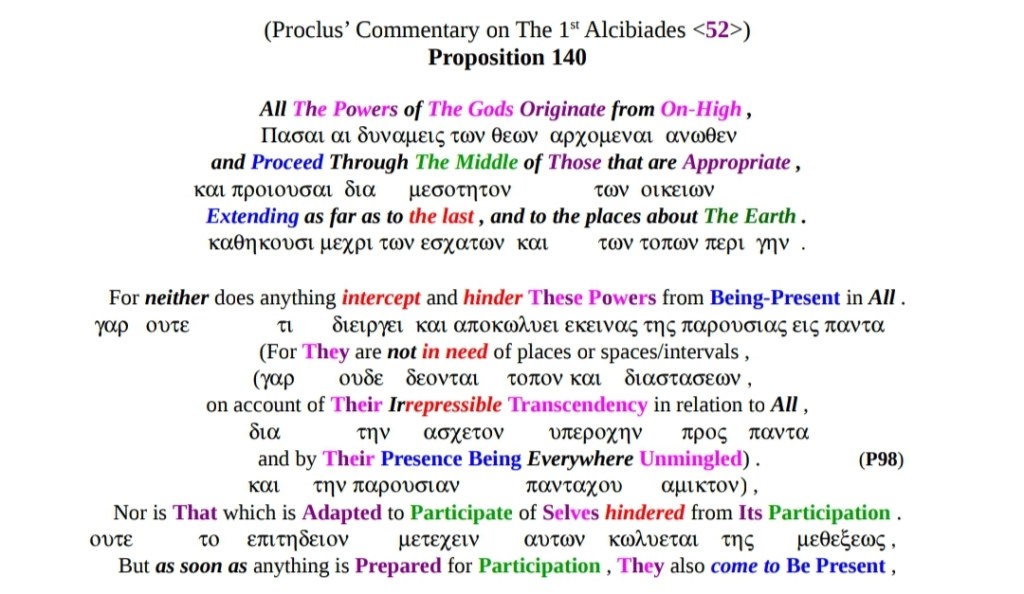
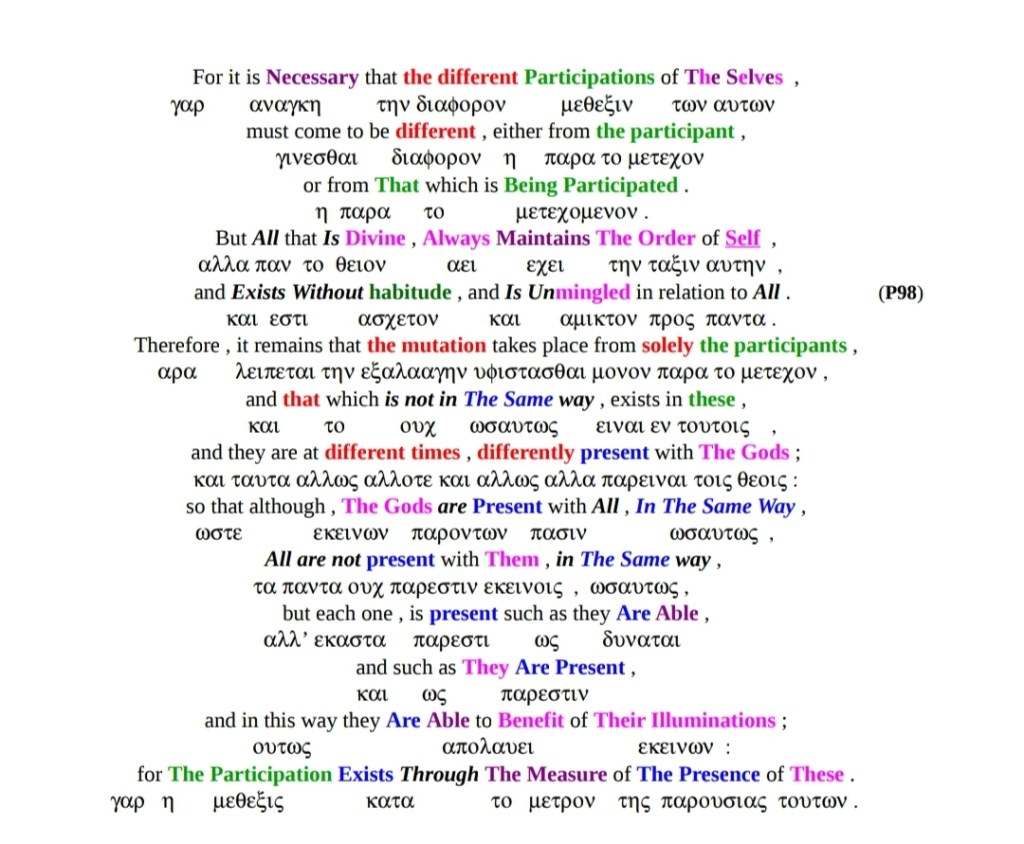
Proclus goes into great detail explaining the relationship of souls and Gods as one of the former being encompassed by and subsumed unto the latter — while clarifying that this does not dimish nor reduce the Divinity of the Gods, as demonstrated in the following translation by Juan and Maria Balboa, also showing the Greek translated from:


Discover more from BREAKING NOUS
Subscribe to get the latest posts sent to your email.
 BREAKING NOUS
Leave a comment