

This article will be a natural successor to The Principle of Inertia, which details a key function in my metaphysical model — that being a property of inertia not limited to physics but indeed inherent to fundamental reality, therefore having a significant bearing on all elements of the operation of reality, most notably the mind. It is the presence of mental inertia and its contrary, mental agency, that will be this succeeding focus.
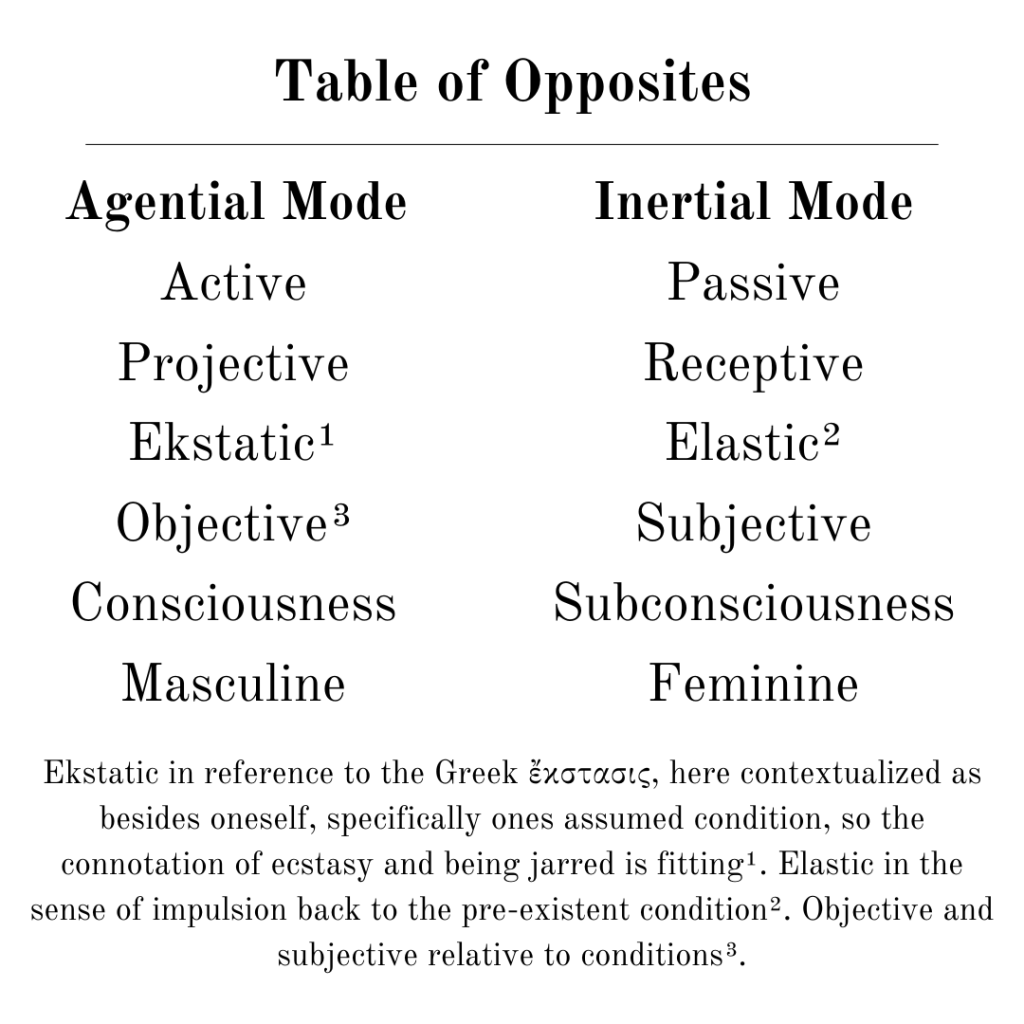
However, given the mind is involved in object-conditions, e.g. an element of your identity which defines you, it will be necessary to zero in on conditional inertia over the more pristine and fundamental inertia of reality — which itself you can think of as a tendency towards unmanifestation, dissolution and entropy if you’re a frequenter of reddit.com. What I mean by conditional inertia is an assistance towards precisely that condition which is already established, not unlike the inertia of physics, it follows that resistance thereto is more difficult, not only this, but it is necessary that something exterior to the condition and conditional impetus in question actually acts on resisting, and here we are hinted with agency.
Beyond physics, the human mind will serve us as an excellent example of conditional inertia. We will only plug in a set of mental conditions posterior to the bare mind, as for example a broad set of conditions that factor into someone’s identity, be they more basic biological realities of a living beings condition or more posterior ideological subscriptions, values, beliefs, opinions and so on. The whole set of these conditions can be said to define the individual against another, for if they were considered only as bare minds there would be little if anything to define the one against the other. The degree to which an individual is conscious of the constituents of this conditional set varies constituent to constituent, we may think of consciousness analogically as a flashlight being shown across a dark room filled with boxes, or maybe trash, or both, the brightness of the light can vary too — and the light might be likened to the agent peering at the objects of its own involvement. Of importance to inertia though, is that the subject will generally experience assistance towards the established contents of their mind, they experience inertia — its nothing special to bring up cognitive dissonance, but I suggest here that the dissonant feeling upon the introduction of the contrary is essentially the subjects reaction to a kind of forced resistance to inertia. Almost like knocking on the agents door, waking him up from a wonderful dream and demanding he come out to play — he’s tired. Indeed he is though, for when this inertial mode of deference and self-reference is over-prioritized, he tends to wake briefly, seek the path of least resistance regarding the dissonant components, usually some kind of justification bordering on self-deceptions, and he sleeps once more. Even meaningless opinions can be incredibly difficult to change, they more often evolve in a manner consistent with the last set, it can be easiest to change opinions meaningfully by way of suggestion or something adjacent, such that the subject subconsciously creates that evolution on their own.
But I have gone and nebulized the matter, so I will take care to concentrate it. I am putting forward two modes by which the mind operates, the inertial mode and the agential mode, the former in essence being the mind operating in reference to itself, and more specifically the contents comprising its condition, and the latter being the minds operating besides itself, again specifically beside what it is, in the sense of the conditions it has assumed. Agency can indeed likewise be thought of in this context as the minds operating in reference to itself-in-itself, barring the posterior conditions, whereas the inertial mode defers the agent to reference to exactly those conditions. Everyone has had conversations with people, wherein you know even as you speak that it’s in one ear out the other, a basic form of this deference, true even if they’re ignoring you because you’re stupid — although this may be a justifiable use of said deference to your more intelligent condition, you specifically — you are very smart. In any case, where the inertial mode prevails, it’s not as though the agent has ceased to exist, like we established before he is just sleeping, maybe comatose. Agency is really only agential if the agency to not operate is an option, the agency to defer to one’s own established condition is a prerequisite for agency to be agency, not to assume the predicate, this is a model after all.
Further, there is a dynamic interplay between these modes in every mind. Though it should be axiomatic by now that the degree to which each is present varies. In the inertia-dominant, had they no agency whatsoever, small changes, even the self-consistent evolutionary changes mentioned earlier would be impossible, as they would instead operate out of pure self-reference, rejecting anything new and exterior, which is never the case — although you could certainly argue for near-exceptions with certain disorders. The point here is that the agential mode, to whatever degree, is responsible for a kind of curation of the objects of continued mental involution, or involvement, and the subsequent evolution of mental condition on the whole. This is to say that the agent is responsible for change, but that change is as a general rule self-consistent with its antecedent condition. General because generally the agent is present but severely inclined to assist inertia, where he is inclined to do no such thing, radical change is possible.
This can be applied to my model of manifestation dynamics, being the mode by which reality manifests, corporealizes and arranges these conditions. It is a topic that should and will follow this one, isolated. Likewise does this modeling have significant bearing on the mechanism back of mental causal power, which may interest you unless you insist on crossing the Leibniz gap and collecting reddit gold. In any case, I’m hoping my beloved reader will take this remember where you’ve experienced relevant interactions — and bring it forward with you.
Discover more from BREAKING NOUS
Subscribe to get the latest posts sent to your email.
 BREAKING NOUS
Leave a comment