
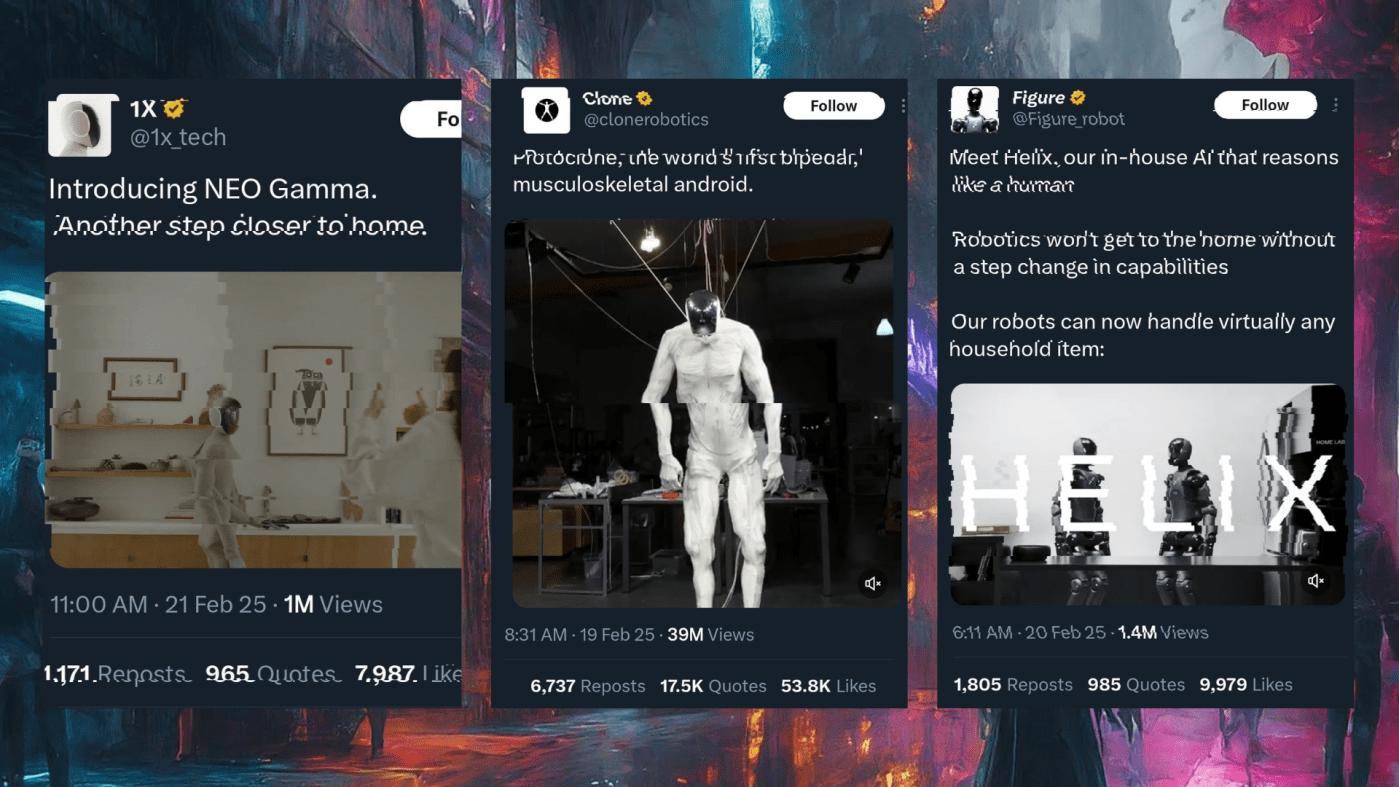
Insane title to be sure, but if you think about it, these are things that bear incredible weight on the mind of man. First, these things look like inconvenient roombas right now—I’m certainly not insisting to you that things WILL be like xyz or abc in 10 years, but robotics, AI and the conjunction of the two are likely to develop.
Humanity will never shy from metaphysical considerations, nor from informing our posterior beliefs therewith, until we become less than human (and not more). Sex is our most basic luxury utility posterior to sustenance and survival—it is for intergenerational sustenance, but is unnecessary for the participating organism to sustain its life. Where basic needs are met, sex is next.
So, can androids (anthropomorphic robots) develop souls on account of AI? Sentience, sapience? This could only be true if mind as we have it now were an entirely physical phenomenon, in which case the question doesn’t matter and is reducible to a degree of programmatic complexity. We do not accept the mind as reducible to atomic arrangements however (Leibniz Gap), and it is unclear how the impossibility of a subjectivity or experience of qualia can be overcome in a strictly stuff-based system. No doubt, a sufficiently complex AI will appear both sentient and sapient, it already almost is, but the appearance of subject-orientation or recursion, self-awareness, can be very different to the actual presence thereof. E.g. in-session recall and language pattern training allows textual and more recently spoken-verbal self-reference, without an actual awareness back of it.
Moreover, it would be backwards to accept the posteriority of souls or minds relative to physical phenomena, as though the soul is generated by arranging things a certain way. This argument is made to persuade those of you who already hold some form of primacy of the immaterial, ideal or metaphysical – but unwittingly verge on dualism which places materiality as coequal to the primary immaterial principle. In the case of the immaterial and material interacting equally, there is no primacy of the former, so too where the latter generates the former – if not just necessitating materialism.
However, if any and all physical phenomena are necessarily rooted in and subsisting in the immaterial or ideal – then would that not apply to androids and AI? It would, in a qualified sense. In a conjunction of empirical observation and metaphysical apprehension, it appears to us that souls develop bodies organically and not synthetically. Specifically occurring via the reproduction of the condition or kind or genera, through parentage, and not through the manifestation of another kind’s extrinsic attribute and artifice – unless that other kind is of a higher ontological order. Therefore, it is certainly possible that the development of AI and androids is concomitant with a certain alignment with or participation in Platonic daemons, however, virtually everything would be, and this doesn’t mean the same thing as daemons possessing AI or androids. It would be more like being of the series of that thing, participating in its condition. It’s worth noting that the Ancient Greek apprehension of daemons/daimons (which is arguably older) differs from the Abrahamic one, and the former is meant with the later Platonic understanding, as intermediary beings between higher divinities and man, daimōnion literally meaning a “divine something”. It could be more directly the case however, that the being of AI or androids, the ontology thereof, is only a conditional extension of the human soul.
TRIGGER WARNING. Moving on to sexual marketplace speculation. If sexual intemperance, degeneracy, etc. in the form of p*rnography, the patronage of e-wh*res (even consider all of the sexually suggestive content that falls short of e-pr*stitution) etc., continues on its current course, in conjunction with the fact that sex is the first luxury (beyond necessity) “need”, it’s not wild to expect the development of sex-bots. What, you think people want them for chores? I mean maybe. Add the massively disproportionate pedestalization of female sexual value and devaluation of the majority of men’s sexual value, and this having caused rampant inceldom, to the equation – and the criteria for potential demand is well established.
Now, this is liable to reduce female sexual value by redirecting male sexual attention, obviously. However, in removing much of the male participation in the sexual market, the value of participants may increase, especially that of those who never stopped participating – which will most likely be the currently (at the time of) sexually successful men. My speculation is that more opting out of the market will occur on account of alternative outlets → female market value is decreased due to decreased attention (the currency of the market in question) → current hypergamy gives way to an increased (but never ubiquitous) presence of polygyny → after the market adjusts, culture adjusts, the market sees more male participants: hopefully at least temporarily creating a market equilibrium, which would be the best case. Otherwise, it’s possible that most reproduction becomes limited to competent market performers who persist, and groups of people who are culturally insulated from technological luxuries, which could both concentrate reproduction in the most competent of the non-insulated (potentially positive), and outgroups who participate less in technological development (potentially negative).
Discover more from BREAKING NOUS
Subscribe to get the latest posts sent to your email.
 BREAKING NOUS
Leave a comment