Introduction To be demonstrated in this paper is not only that things have a way that they are, but also that any such way they may be is salient; that these ways a thing may be are not isomorphic to conceptions or ideations of the thing; that to each identity an interest corresponds; a model... Continue Reading →
AI & Androids: Metaphysical Implications and Effects on the Sexual Marketplace, NOUSLETTER V
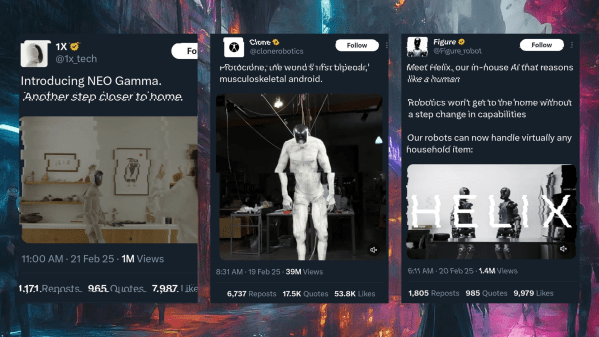
Insane title to be sure, but if you think about it, these are things that bear incredible weight on the mind of man. First, these things look like inconvenient roombas right nowโI'm certainly not insisting to you that things WILL be like xyz or abc in 10 years, but robotics, AI and the conjunction of... Continue Reading →
Matter as Mnemonic Capacity, NOUSLETTER IV
In Ennead II.4 Plotinus anticipates Chris Langan's concept of syndiffeonesis with intelligible matter, at least to some capacity, seeing as intelligible matter is called for as a substrate to relate differentia in the way of plural Forms. The matter principle in question present to both the second and third hypostases acts not only a relational... Continue Reading →
Pythagoreanism: The Table of Opposites, NOUSLETTER III
As we all know well, Pythagoras and those in his tradition that followed, ground their metaphysics in number and had a well developed system of numerology, within the context of which each number is a particular system unto itself, each reflecting to various meanings relevant to the number in question. For example, the Dyad, a system of twoness, extends its meaning to indefiniteness, unlimitedness, ration in proportion, matter, gender and so on.
Nothing From Naught: On Ex Nihilo and Ex Deo, NOUSLETTER I
I've recently begun reinvestigating the divide between Creatio Ex Nihilo (creation from nothing) and Creatio Ex Deo (creation from God), initially, I had taken Creatio Ex Deo to be obvious. In response to the suggestion of something from nothing, I would say Ex Nihilo Nihil Fit; from nothing, nothing comes. In light of personal considerations, I aim to subject the two to a dialectical exercise, and resolve the contention precisely.
Monism and its Consistency in Principle
Monism, predicating a universal principle unity, therefore demands consistency in this principle throughout the whole and its parts. The principle at hand, which can be considered the underlying reality principle, is therefore non-private โ as in there is no lack of it, which also extends to there being no gradation of it, or lessening or... Continue Reading →
Primer on Metaphysics: Self-particularization and Self-definition
The system I'm putting forward starts with a few fundamental assertions made about the One/the Absolute, which is indeed maintained to be Absolute, which is essentially that which is totally universal (non-particular) and without privation. This is necessary for a foundational metaphysical principle, because if there is something external to it (which is the only... Continue Reading →
Does Monism lend itself to Universalism?
A popular critique against monism (though it does nothing to rebuke it) is that monism lends itself to several kinds of universalism, chiefly religious and socio-political universalism. It's no secret that a great many people resent the foremost universalist religions on the world stage โ Christianity and Islam, both of which are rooted in Abraham... Continue Reading →
Monadology Commentary: Leibniz’ Plural Idealism
Introduction Leibniz uses the Greek term Monad to describe a simple substance, which I will then describe as what is essentially a unitary system unto itself. This commentary will begin with allowing Leibniz himself to introduce his ideas, with brief commentary, followed by an important development and exposition on the work at large with continued... Continue Reading →